The Market Is Not The Problem. You Are
9 November 2026
It’s the implementation, stupid
Let me start by making three things clear:
- The market isn’t dead. Clients are still engaging with agencies to deliver analytics services, and those agencies are still delivering high-quality work in a profitable manner;
- The demand for implementation was artificially inflated by GA4 and has since retreated to a more normal baseline level;
- If you’re over-concentrated on implementation, it’s going to look like the market is bad.
I think so many shops specialise in implementation because it’s easy to sell.
It isn’t easy to do. The amount of super-incredibly mega-clever stuff that the sharpest minds in the world at implementation regularly turn out really should have our collective jaw agape, and I was certainly in awe of the work turned out by the implementation specialists I was lucky enough to work side-by-side with in my agency days.
But I do think it’s easy to sell.
Here’s why:
- A company realises they have a data problem
- They look for someone that can fix that data problem
- They find you
- You deliver an audit + an implementation + testing
- Client is happy
- They pay you
- You are happy
- Wait for #1 to happen again
There’s not much of a conventional “sales process” in that arc. A prospect comes to you ready to buy, not quite waving a fistful of cash in your face a la the familiar “Fry from Futurama” meme that I could include here, but don’t, because I know you’re more intelligent than someone that needs a meme to absorb information.
All you need to do with that prospect is convince them that:
- You know what you’re talking about
- You’ve seen this problem before
- You can help for £££
(I’m oversimplifying, but I expect you can see where I’m going with this.)
By the time this client gets in touch with you, they’ve established their own need.
They’ve determined they want to go out to market.
They already know what their problem is, and just need to find the right person to fix it.
Don’t get me wrong, this is a positive outcome. You won’t win the work if you’re no good, and you won’t have won it without a solid track record which you also wouldn’t have if you weren’t good.
But look at what’s missing…
There’s no discovery. There’s no ICP matching. You’re not actively sitting down with the client to help identify a problem that can be solved, you’re not ideating or imagineering a new product or service line that will change their world.
All you’re doing is agreeing with their assessment that everything is wrong and that everything will be solved by reaching for the stars, and shooting for the unicorn-shaped pot of gold at the end of the utopian rainbow: Perfect Data.
Can we go back to GA4 implementations please?
I mean, obviously let’s not. People working in analytics hated those times for… reasons.
The transition to GA4 was quite different to anything that this industry had seen before. Sure, we had upgrades through GA’s iterations, but in Google-land the upgrade to GA4 was the only one that had zero backwards-compatibility, a ridiculously wide usage base, a brand new data schema that alienated normal people, and a hard-stop sunset deadline after which the old setup would simply keel over and die.
You can read all the sales books you want, they’ll talk extensively about creating at least some degree of urgency in the mind of the buyer.
With GA4, Google did the industry an unexpected solid, by creating such a large amount of urgency, that selling became easier than it had ever been before.
This industry has never seen such a powerful and globally-consistent force driving sales, and in this age of fragmentation, I doubt we will ever see anything of its kind again.
(Unless, that is, a future-state GA5 becomes just as much of a clusterfudge… but hopefully that’s not something we need to worry about for the foreseeable.)
On the back of this historic rush of implementation work, lots of things happened:
- Established analytics agencies scaled
- Generalist digital marketing & performance agencies launched analytics practices
- Individuals quit their jobs and set up solo shops
…and best of all? It worked out for everyone!
With so much implementation work needing to be done, so many comms from Google on the sunset dates, and so many people able to deliver the work, I expect a lot of money was made. How much, I cannot say, nor can I say whether agencies would have had a quieter time had GA4 been in better shape when it was released upon the world.
Anyway.
Now, don’t get me wrong: you’re not going to scale or be successful just based on your ability to sign clients.
You actually need to be able to deliver the work well, too.
Which brings me to….
But big agencies suck, don’t they?
When I had my agency, I would regularly bust a blood vessel (not literally) talking about how my small, senior, dedicated team was much better at analytics than a global agency, a holdco, or a large local SEO/Ads agency that also delivered analytics services.
I can look back on this and feel slightly cringey at the way I defended our work in that way, but I also feel that you need to think of your agency in such passionate terms in order to be authentically successful. (I might do a newsletter on that topic, I find it interesting.)
I still think small and dedicated teams will always do better work than some Big Agency.
If you’re a smaller shop, you’re probably delivering better work than a digital generalist Big Agency right now:
- you’re more in tune with the tech;
- you don’t “mark your own homework” *takes drink*
- you spend more time debugging weird problems than they do so you’re better at solving those problems that come up again in future;
- and chances are you’ve probably inherited an implementation from a Big Agency and found it vanilla, nuance-free, barely-functional garbage.
Which is a long way of saying:
I agree, you’re better than Big Agency…..
….at doing the technical part of the work.
But small agencies suck, don’t they?
Big agencies are better than you are at selling.
They have sales teams! Growth teams! Sales and growth teams! Strategy teams! Client Success Teams! Who even knows, the point is they can afford to pay people whose only job is to sell, and to upsell.
They adopt wonderfully effective strategies like Land And Expand, which is where you win a client for one “thing” and then gradually sell them on other “things”.
(For instance: a client comes to Big Agency with a pitch for paid media. Big Agency goes super-low on margins, bundles in a load of services, essentially losing money on the deal on the basis that they’ll be able to also sell-in things like SEO, analytics, creative, influencer marketing, etc…. so, do whatever you can to Land, then recover your revenue when you Expand.)
I’m not saying you should go low on your margins.
And I’m definitely not saying you should go and set up an influencer marketing division.
Where I think there’s a lesson here loops back to that idea of Perfect Data from a little while back.
Let’s take another look at how that process might work, with this image that I definitely totally and absolutely made with AI:
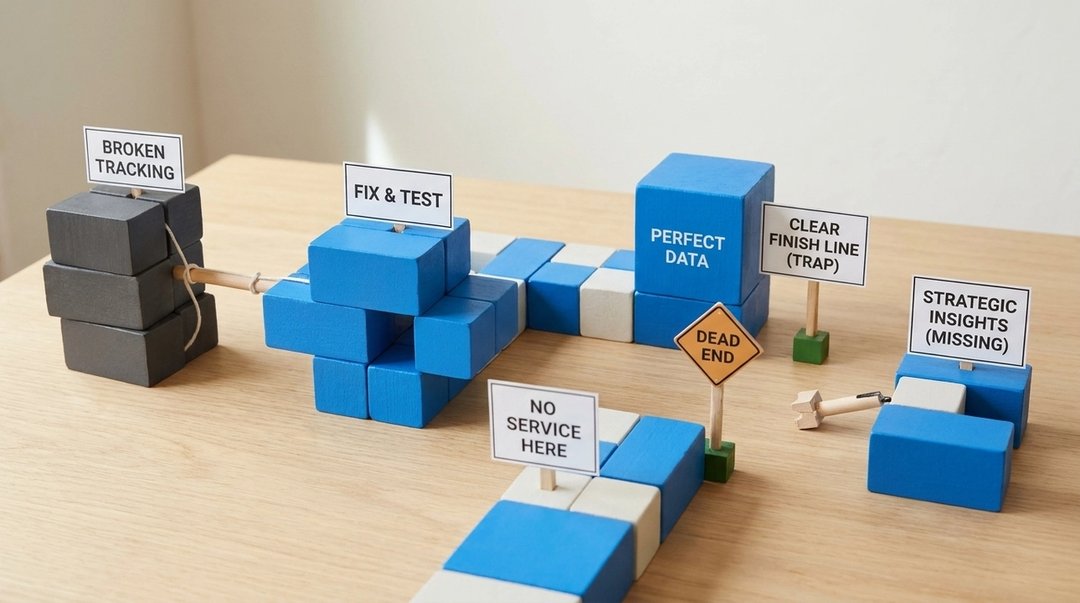
This was made with AI.
Let’s assume a client comes to you with Broken Tracking (the grey blocks on the left).
You sign the client, schedule the work, complete the Fix & Test, ship it as “done” and the client can bask in the glory of having Perfect Data!
End of story.
Send invoice, get paid, life goes on.
If we start to put in an analogue to the Big Agency’s idea of Land & Expand, it might work out differently:
- Client comes to you with Broken Tracking
- You Fix & Test, confirming everything now basks in the glow of Perfect Data
- You invoice, then you offer the client some Strategic Insights
- Suddenly you have a bridge beyond Perfect Data, and you can bill the client for more work instead of waiting for the next Broken Tracking to come along.
Not the end of the story.
Send invoice, get paid, continue working with client, send another invoice. Repeat.
How about an example? I’m glad you asked
Let’s have an example then, because everyone loves a thought experiment.
I want you to imagine a client that comes to you with an assignment like this:
We have a new campaign launching next month.
It’s going to have a lot of paid and organic activity, and we’ll also be sending out to our email audiences.
There’s going to be multiple landing pages, with AB testing on everything, and we’re also setting up a dedicated funnel for the transaction process.
Devs have finished it in UAT, and we’d like you to build out the tracking for us before it goes live.
-- Mrs A. Client, Nowheresville
Bread and butter work, right?
Let’s further imagine that there are two ways of delivering this work to the client.
When it comes to the delivery, which one of these options do you think will produce the best outcome for your business?
And which one is closer to how your business works now?
Scenario A
- Scope the work
- Client approves
- You build out the UTM matrix
- Design the dataLayer and produce documentation
- Configure the tags
- Support the devs
- Test in UAT
- Test in Prod
- Invoice
- Get Paid
Scenario B
- Scope the work
- Add extra scope for some reporting at 1, 5 and 14 days on how the campaign is tracking
- Add extra extra scope for 30 support hours for training, fixes and refinements
- Add extra extra extra scope for some of your time sitting with their team after the campaign has finished to analyse it live together
- Client approves
- Build out the UTM matrix
- Design the dataLayer and produce documentation
- Configure the tags
- Support the devs
- Test in UAT
- Test in Prod
- Invoice
- Get Paid
- Do the reporting & analysis work
- Get paid again
- Travel to their offices for the in-person analysis working group
- Get paid again
- “What else could you do for us?”
- etc etc etc
The difference between these two scenarios, other than the roaring commercial upside enjoyed by Scenario B, is that the second option requires being proactive in suggesting additional work that can add value to the client.
These are the conversations that, if you find the market poor at the moment, you are definitely not having.
I realise that not every client will say yes.
I understand that their budgets are always slim.
But if you stop at Perfect Data, and you don’t offer this extra work, you know exactly what’s going to happen: the client views you as an implementation specialist, you’re always going to be waiting for chunks of work to land, and have a hard time reaching the escape velocity you need to hit to get away from unpredictable, lumpy revenue.
When someone complains about “the market”, what I hear is the voice of someone that hasn’t tried to do anything different.
Or if they tried it once, it failed, and so they stopped trying it with another client.
Or they tried it, it didn’t land, and instead of reconfiguring the offering they gave up.
If you’re concerned about the market…. when (honestly) did you last reconfigure your offering?
Do try this at home
Okay. Practically, then, what can you do to fix this?
Like this:
- Set aside at least one day to develop new service lines; call them “products” if you prefer, but essentially it means a thing that a client will pay you to do
- Remember that if you can save a client money they pay you once; if you can make them money, they pay you many times (I think this is one way for you to move from being an order-taker to a strategic partner, but that’s a topic for another newsletter)
- Aim to come up with no less than three new service lines that can be delivered after Perfect Data has been achieved
- Build a one-pager for each, give a dollar value to each
- Don’t use sodding Claude for this by the way, it should come from your authentic expertise and if it doesn’t then you’re deservedly doomed
- Go through a list of all clients you’ve worked with in the last 24 months
- Contact them with info about your new things they can do with the Perfect Data you gave them
- Aim to sell (land and expand!) this to 20% of your last 24 months’ clients
- If you don’t sell anything, it’s still not “the market”, it’s your positioning and approach. So try again.
And one final “hot tip”…
Oh and the hidden step from that list above?
- Tell me how it goes (seriously, please do!)
But hey, enough of my yakkin’. I’ll catch you next time!
Thanks for reading. No AI was used in the creation of the words you just read.
I do this for a living. I work with agencies and consultancies around the world, providing the support I wish I’d had throughout my journey of starting, scaling, and selling an agency.
If you think you could benefit from what I know how to do, I welcome conversation: hit reply.
On this site, you’ll also find information about the Analytics Consultants Circle, a free monthly peer-group call that I moderate, where solo and small-team consultants share battle stories from the field, and we talk about the challenges you face when you grow and scale a business.
The last movie I watched: Philadelphia (1993).
The Business of Analytics lands fortnightly. If this one was useful, the next one probably will be too.
Subscribe ↗